144.600 MHz – Successful 40 kHz DVB-T Experiment from Luxembourg
(2026-11-11) PE1ITR
On Wednesday, 4 November 2026, I operated portable from Hosingen, Luxembourg (JO30BA), as LX/PE1ITR to experiment with narrowband DVB-T on 144.600 MHz. The experiment took place between approximately 17:55 and 18:40 UTC.
The objective was to demonstrate that digital amateur television is possible within a bandwidth of just 40 kHz, making it particularly interesting for 144 MHz DATV contest activity.
The Transmitting Station
I used my own experimental DATV transmitter software with a LimeSDR Mini v1.2, followed by a RF amplifier delivering 40 watts DVB-T and a 9-element Yagi antenna. The DVB-T signal used FEC 1/2 and a guard interval of 1/32.
For this experiment, I transmitted a small 120-pixel contest number image generated using my ATV Contest Number Generator. Previous laboratory tests had already demonstrated that moving video and animations are also possible within this narrow bandwidth, although at reduced image quality and frame rates.
Reception Reports
Four stations in the Netherlands participated, using RTL-SDR receivers with my experimental DVB-T receiver software on Windows computers.
| Callsign | Operator | Locator | Distance |
|---|
| PA0T | Jaap | JO33JC | 346 km |
| PA3BYV | Poll | JO32NX | 336 km |
| PE1BBI | Gerard | JO33HJ | 377 km |
| PA3FXB | Jan | JO33KC | 347 km |
Approximate great-circle distances between locator centres.
PA0T, PA3BYV and PE1BBI successfully decoded the DVB-T video. Jan PA3FXB could see the signal in his SDR waterfall, but local interference prevented successful decoding. Poll PA3BYV coordinated via Zello and email and supplied a screenshot of the received picture.
The observed reception threshold was approximately 5.5 dB SNR. Aircraft scatter played an important role, producing rapid signal variations. Gerard reported signals varying from S0 to S3, with peaks up to S7 during aircraft reflections.
Reception screenshots
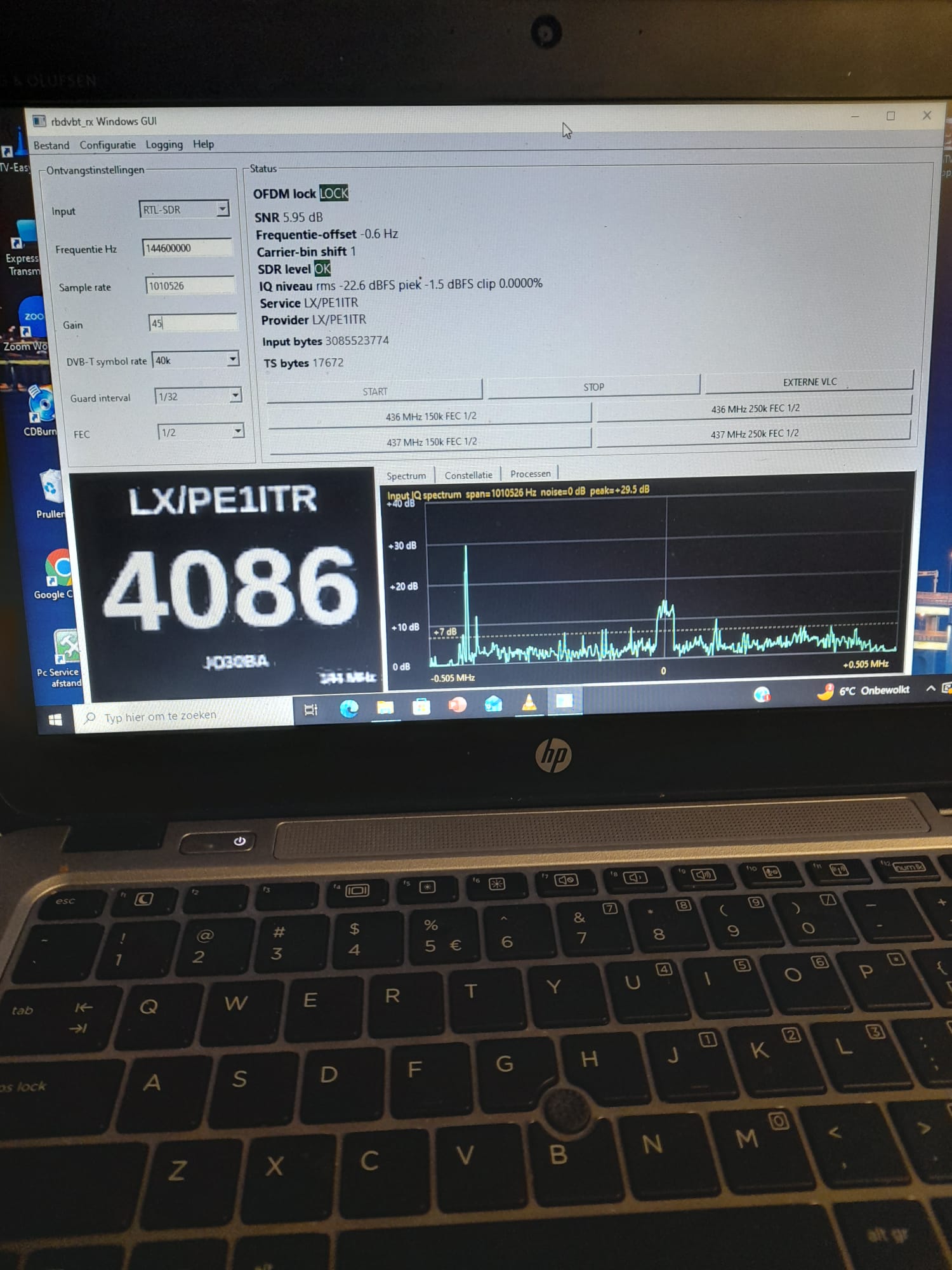
Reception screenshot from PA0T.
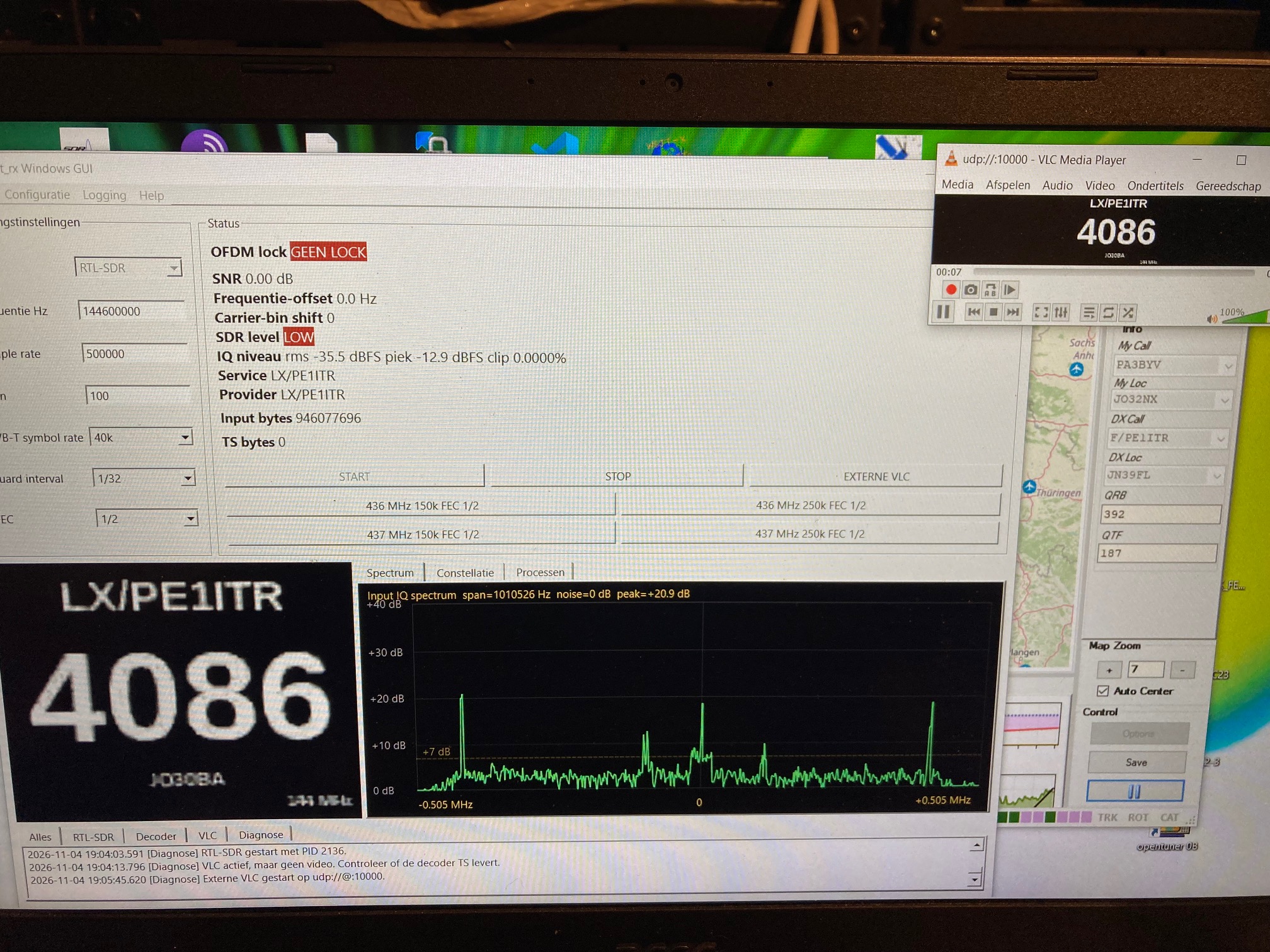
PA3BYV: recovered contest number picture from LX/PE1ITR.
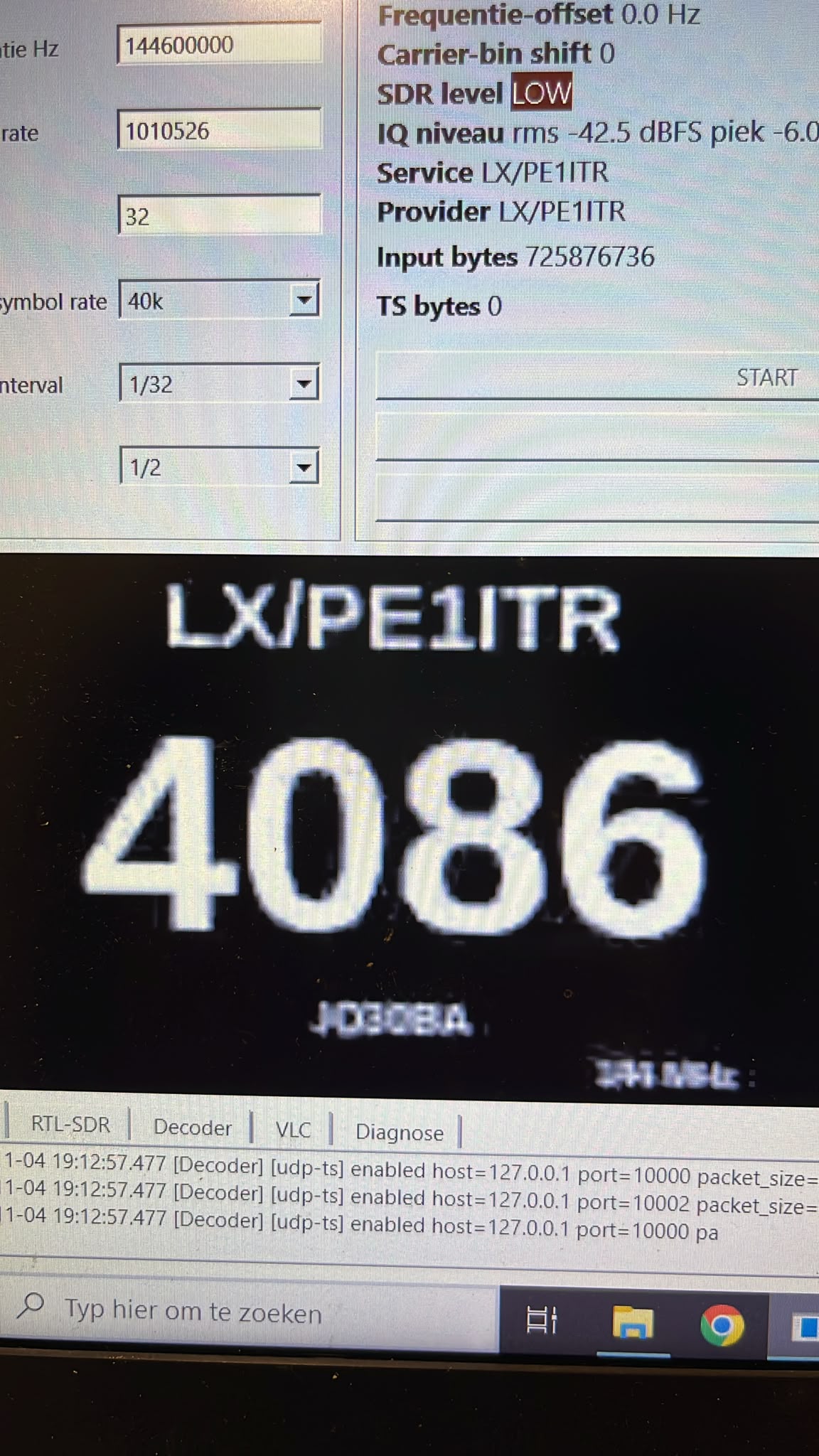
Reception screenshot from PE1BBI.
Poll PA3BYV had also prepared a DVB-T transmitter using my software. He successfully generated a DVB-T signal locally, but the spectral quality after his RF amplifier was not satisfactory. He therefore decided not to transmit the amplified signal over the air. We hope to complete a two-way DVB-T test next time.
A Brief DVB-S Comparison
Towards the end of the experiment, I briefly switched to DVB-S at 35 ksym/s with FEC 1/2. None of the receiving stations managed to decode the signal during this short test. From previous experience, we know that DVB-S reception at such low symbol rates can be challenging. The short test does not establish a definitive performance comparison.
Spectral Bandwidth: An Important Result
Before the experiment, I measured the DVB-T signal with a Siglent spectrum analyser after the final RF amplifier, at the full output power of 40 watts. The measured 99% occupied bandwidth was only 39.583 kHz.
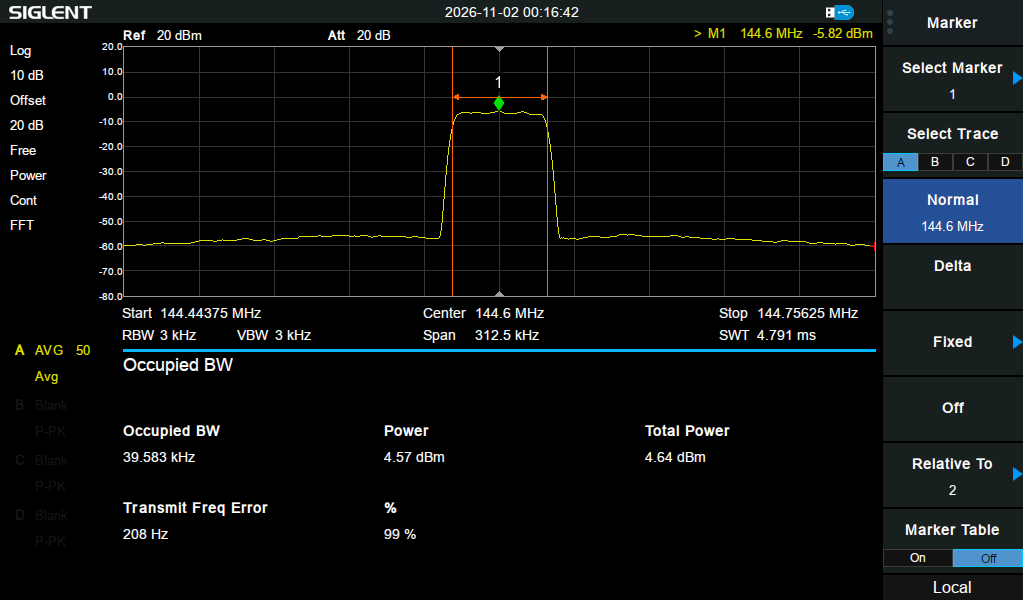
Measured 99% occupied bandwidth of 39.583 kHz, after the final RF power amplifier at 40 W output.
This is particularly interesting for German radio amateurs, who are subject to an explicit 40 kHz bandwidth limit on 144 MHz. In September 2026, the IARU Region 1 conference removed the maximum bandwidth restriction from the 144.500–144.794 MHz all-mode segment of its bandplan. National regulations, however, still apply.
Our experiment demonstrates that narrowband DVB-T offers German stations a practical way to participate in 144 MHz DATV contests, provided their transmissions meet the applicable national bandwidth and unwanted-emission requirements.
Conclusion
With only 40 watts, a 9-element Yagi and a DVB-T signal with a measured 99% occupied bandwidth below 40 kHz, we successfully transmitted recognizable digital television pictures over distances of more than 370 km.
The results are encouraging for aircraft scatter communication and international DATV contest activity on 144 MHz. The experiment also provided useful feedback for further software development. A newer project, Linrad DVB, has since been developed; it was not available at the time of this experiment.
Many thanks to Jaap PA0T, Poll PA3BYV, Gerard PE1BBI and Jan PA3FXB for their participation, preparations and reception reports!
73, Rob PE1ITR
HOME | Go Back