About this system
This system gives radio propagation warnings on VHF and higher when conditions are good from Maidenhead locator JO21QK. It has been continuously running since 2006, and all information has been stored in a database since then.
Its main purpose is to signal Sporadic E-skip propagation on 144 MHz. The other warnings and statistical information are mainly the result of personal curiosity. The system is not primarily intended as a 24/7 service for others, but as a way for me and friends to better understand radio propagation and enjoy working DX on VHF.
Spot sources
The most important spot source is the PSKreporter MQTT service. The classic DXCluster is also used, but it only represents a small percentage of the incoming spots. Other monitored sources include FMLIST, contest logs, beacons, ionospheric data, and magnetometers.
The PSKreporter stream contains a lot of useful information, although automated interpretation is still being improved because it can cause irrelevant alerts.
Warnings and validation
At present, the system supports warnings for E-skip on 50, 70, 100, and 144 MHz; multi-hop Es or F2 on 50 MHz; tropo on 144 and 432 MHz; and aurora on 50, 70, and 144 MHz.
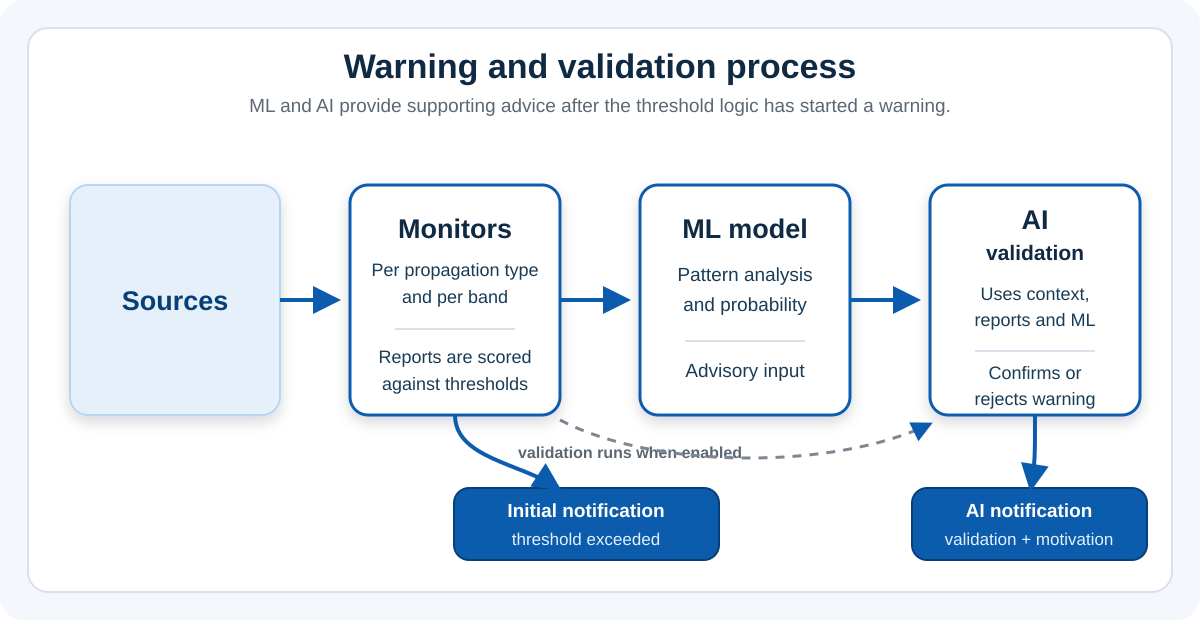
Experimental ML and AI validation are used as supporting analysis. They help judge whether an alert is likely to be valid, but they are not the only basis for issuing warnings.
Incoming reports from several sources are evaluated by propagation monitors for each band and propagation mode. When a configured threshold is exceeded, the system sends the initial warning notification. If validation is enabled for that alert type, the same context is also evaluated by an ML model and then by AI validation.
The AI validation step uses the available report context and, where available, the ML result as advisory input. It then sends a separate follow-up notification that confirms or rejects the earlier warning and includes the motivation for that judgement.
Live information
For current information, open the status page and select the band and propagation mode you want to inspect. Click that selection to open the detail page. The detail page contains a link to the current live overview for that specific band and propagation type.
- Open Current propagation status.
- Select a band and propagation mode.
- Click the selected item to open its detail page.
- Use the live overview link on the detail page.
Technical background
The core of the system is a MariaDB database, mainly powered by the excellent LiveMuf v7 software by G7RAU. On top of this runs home-written analysis and alert software. Alerts are sent by Telegram to the group "vhf_dxalerts" and by POCSAG through DAPNET on 439.9875 MHz. Email and Twitter alerts are no longer sent.
Note: The best way to work DX is always to be QRV.